The temptation remains to build AI strategies around products.
“Should we use Claude?”
“What about Gemini?”
“Are we standardising on Copilot?”
“Should we build agents?”
“Apparently everyone is using MCP now.”
These may be useful technology questions. They are terrible starting points for business strategy.
IT strategic-planning guidance starts somewhere much less glamorous: understand the organisation's objectives, assess the capability required to deliver them, allocate budgets against impact, determine how success will be measured and document the strategy clearly.
That sounds almost disappointingly sensible.
The same principle appears in Gartner's work on AI value. Its first-quarter 2026 research explicitly warns that time saved is not necessarily money saved. Seventy-four percent of CFOs surveyed reported productivity improvements from AI through time savings, but those minutes do not magically stroll into the P&L carrying suitcases of cash. To realise financial value, processes and operating models often need to be redesigned around the productivity gain.
Oracle NetSuite's paper Modeling AI ROI Like a CFO, Not a Vendor reinforces this. It argues that AI investment cases differ from conventional IT investment because adoption, output quality and benefits are uncertain. Its framework recommends probability-weighted cash flows, realistic adoption curves, allowance for benefit decay, explicit costing of failure, recognition of foundational investments and portfolio-level evaluation.
That should change how businesses build their AI stack.
Start with something like:
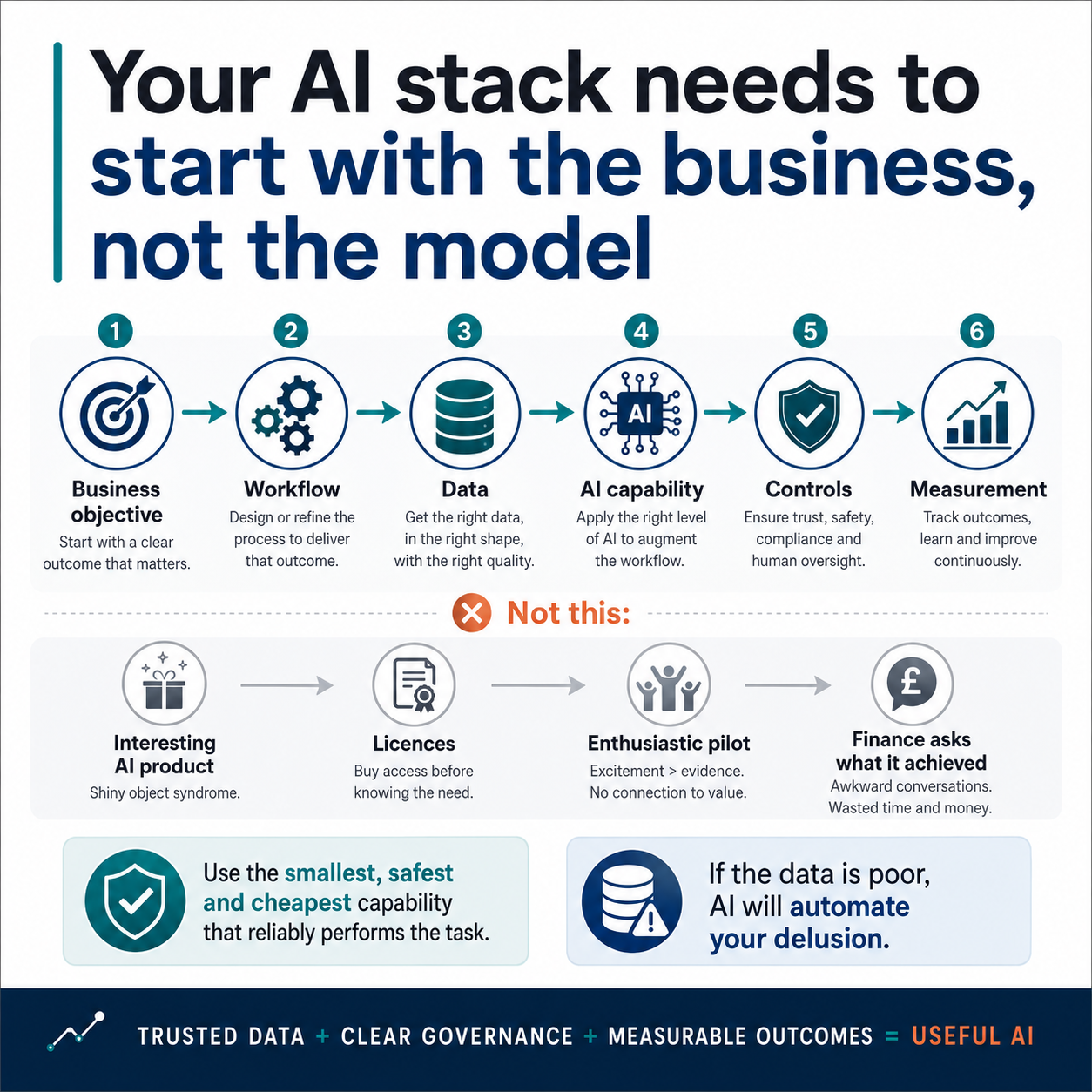
Business objective → workflow → data → AI capability → controls → measurement.
Not:
Interesting AI product → licences → enthusiastic pilot → six months later somebody asks Finance what it achieved.
The latter is not an AI strategy. It is an expensive hobby.
The model may become the least interesting part of the stack
Ramp's free LLM router offers a useful glimpse into where AI infrastructure may be heading.
Ramp has exposed technology capable of routing requests between different language models according to quality, cost and other criteria. The strategic significance is larger than the router itself. The real commercial opportunity here is having a control layer for AI expenditure. That matters because organisations are moving from “one user, one prompt” towards agentic workflows where a single business task can trigger dozens of model calls.
Model choice therefore becomes dynamic.
You may want the strongest available model for strategic reasoning, a smaller model for classification, another for code, an on-device model for sensitive tasks and perhaps no LLM at all for deterministic processes that can be handled more reliably with traditional software. New research into lookup-based architectures suggests that some AI workloads may eventually even be performed using radically less compute than conventional neural networks. They are not about to replace frontier LLMs, but they demonstrate an important principle:
AI efficiency may become as important as AI capability.
The best enterprise architecture is unlikely to be “send everything to the biggest model available.”
It will increasingly be:
use the smallest, cheapest and safest capability that reliably performs the task.
That is good engineering and it is also good finance. Conveniently it is also good sustainability.
Data quality remains the unglamorous superpower
We can give an AI agent a charming name, a carefully designed avatar and enough autonomy to book meetings, generate proposals and interrogate the ERP. If the underlying data is rubbish, we have merely created a very fast employee who is confidently wrong.
Oracle NetSuite's AI Insights You Can Act On makes this point particularly well. AI analyses the information available to it; it does not independently determine whether the chart of accounts is sensible, whether transactions are consistently categorised, whether historical data is complete or whether organisational changes have made previous classifications obsolete.
Inconsistent inputs can produce misleading analysis with considerable confidence. That observation applies far beyond finance.
If your CRM contains duplicate customers, incomplete opportunities and fictional close dates inserted because the Sales Director wanted the pipeline report to look cheerful, AI will not fix reality. It will automate your delusion.
So an effective growth-oriented AI stack requires a trusted data layer: clear ownership, consistent taxonomies, useful metadata, permissions, provenance, retention rules and mechanisms for validating critical information.
This does not make for exciting conference photography.
However, it does make AI useful.