For the last two years, AI has been sold as the answer to almost everything.
More productivity.
Lower costs.
Faster decision-making.
Less manual work.
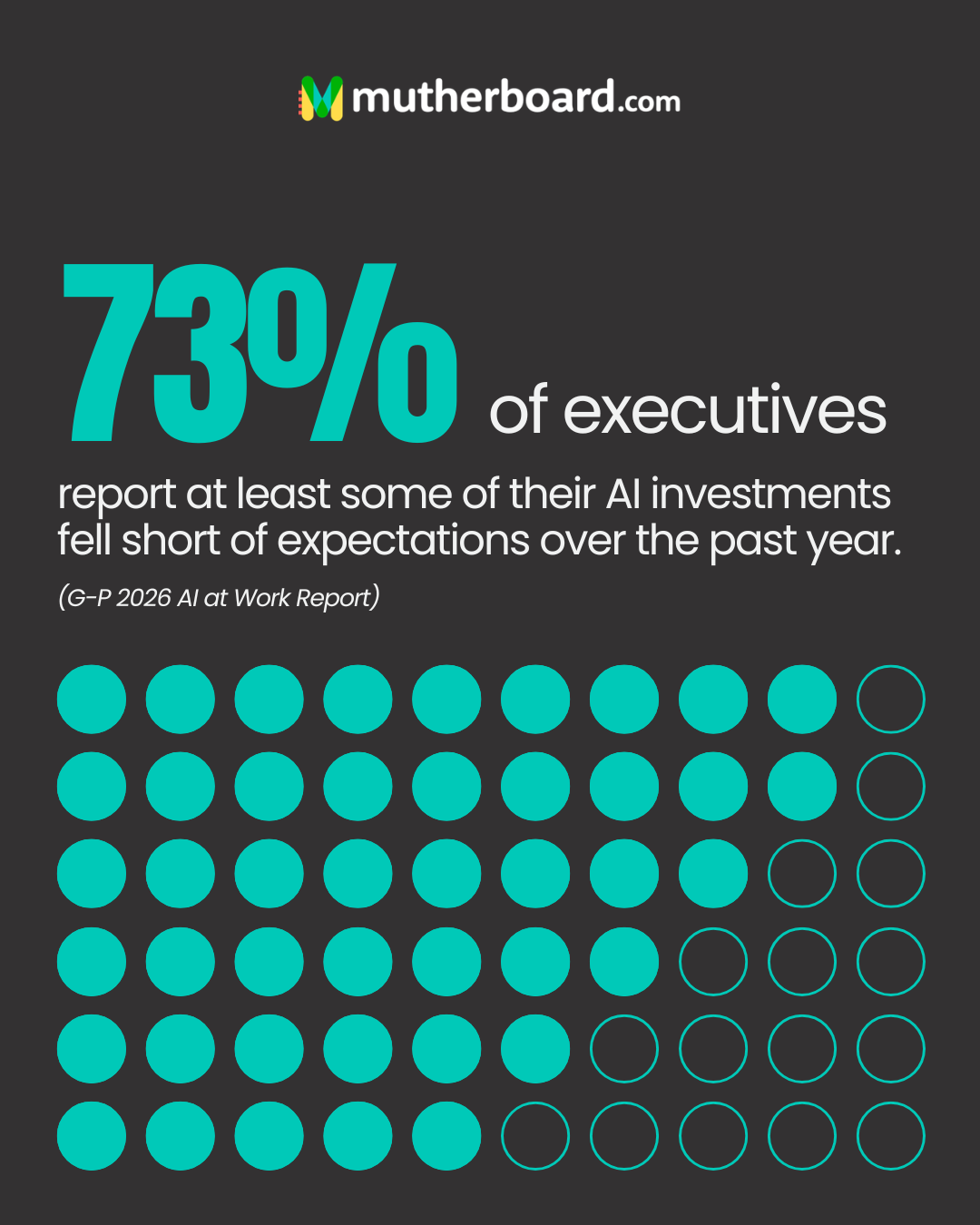
And yet, according to the G-P 2026 AI at Work Report, 73% of executives say at least some of their AI investments fell short of expectations over the past year.
That number is surprising, but it is not shocking.
Because most businesses are making one critical mistake:
They are layering AI onto broken workflows and expecting transformation.
AI is not the strategy
Too many companies approached AI like a software upgrade.
Buy a tool.
Roll it out.
Wait for productivity to happen.
But AI is not magic.
If your processes are fragmented, your data is messy, your teams are drowning in admin, and nobody knows where work actually lives, AI often just accelerates the chaos.
You do not get better outcomes simply because a process is faster.
You get better outcomes when the process itself improves.
The ROI problem nobody talks about
When executives say AI is underperforming, what they often mean is:
- Teams are not adopting the tools consistently
- Employees are using AI inconsistently or not at all
- Productivity gains are hard to measure
- Teams still spend too much time on repetitive admin work
- AI creates output, but not necessarily outcomes
This is where expectations and reality collide.
Many organizations expected instant returns.
Instead, they found that implementing AI still requires operational thinking, change management, and workflow redesign.
In other words:
AI does not remove inefficiency by default.
It amplifies whatever system already exists.
A good system becomes faster.
A bad system becomes faster at being messy.
The companies getting it right are doing something different
The organizations seeing meaningful ROI are not necessarily using more AI.
They are using it more intentionally.
They start with questions like:
- What repetitive work is slowing our team down?
- Which tasks are eating time without adding value?
- Where are people stuck in manual processes?
- What can be automated without sacrificing quality?
Then they build workflows around those answers.
The result is not just “AI adoption.”
It is measurable operational improvement.
Less admin.
Fewer bottlenecks.
More time for meaningful work.
We might be entering a new phase of AI
The hype cycle is shifting.
For a while, the conversation was: Who is using AI?
Now the question is becoming: Who is actually getting results from it?
And that is a much healthier conversation.
Because the future will not belong to the companies with the most AI tools.
It will belong to the companies that redesign work in a way that makes people more effective.
AI is powerful.
But only when it is connected to processes that actually make sense.
What do you think? Is AI underdelivering, or are businesses still learning how to use it properly?